Perhaps you find yourself squinting to read a distant road sign, or perhaps you have to hold a restaurant menu at arm’s length just to make the words come into focus. These common vision challenges often point to two different conditions: myopia and hyperopia. Understanding the difference between them is your first step toward seeing the world more clearly, and our team at Central Eyes Optometry can help.
Myopia, also known as nearsightedness, makes distant objects appear blurry, while hyperopia, or farsightedness, typically makes close-up objects seem out of focus. Both are related to how your eyes bend light, but they affect your vision in opposite ways.
A comprehensive eye exam is the right way to determine whether you have one of these conditions.
Myopia and Nearsightedness Explained
If you can see your book or phone screen perfectly but the television across the room looks fuzzy, you might be experiencing myopia. People with nearsightedness find that objects up close are clear, while things farther away lose their sharpness.
This happens when the shape of your eye causes light to focus in front of the retina—the light-sensitive tissue at the back of your eye—instead of directly on it.
For children, myopia management strategies are important for slowing down the condition’s progression.
Common Signs of Myopia
You might notice a few common signs if you have myopia:
- Headaches that come from straining your eyes
- A habit of squinting to see things far away
- Difficulty reading road signs or presentation slides
Hyperopia or Farsightedness Explained
On the other hand, you may have hyperopia if you can easily spot a friend from across the street but struggle to read a text message. With farsightedness, distant objects often remain sharp while close-up tasks become a challenge.
Like myopia, this condition is also related to the shape of your eye. For those with hyperopia, light focuses behind the retina. This common vision condition can cause nearby objects to appear blurry and indistinct.
Common Signs of Hyperopia
Farsightedness can show up in different ways, especially after you focus on something up close:
- Eye strain or fatigue after reading or computer work
- Eyestrain, including aching or burning sensations in your eyes
- Headaches that develop after doing close-up tasks

Key Differences & Similarities
How Your Vision Is Different
The simplest way to remember the difference is to think about the distances at which you struggle to see clearly. Myopia creates difficulty with your distance vision, making far-off objects hard to decipher. Hyperopia primarily affects your near vision, making it tough to focus on things right in front of you.
The Cause of Blurry Vision
Although they affect your vision differently, both conditions are what eye care professionals call refractive errors. This term just means that your eye doesn’t bend—or refract—light correctly. Instead of focusing light precisely on the retina and producing a crisp image, your eyes cause light to fall in front of or behind the retina, which results in blur.
What About Astigmatism?
You may have also heard of astigmatism. This is another common refractive error that can happen on its own or along with myopia or hyperopia. Astigmatism occurs when your cornea or lens has an irregular curve, meaning that it’s shaped more like a football than a perfect sphere.
This uneven shape prevents light from focusing on a single point on your retina. As a result, astigmatism can cause your vision to seem blurry or distorted at all distances, not just near or far.
Solutions & Your Next Steps
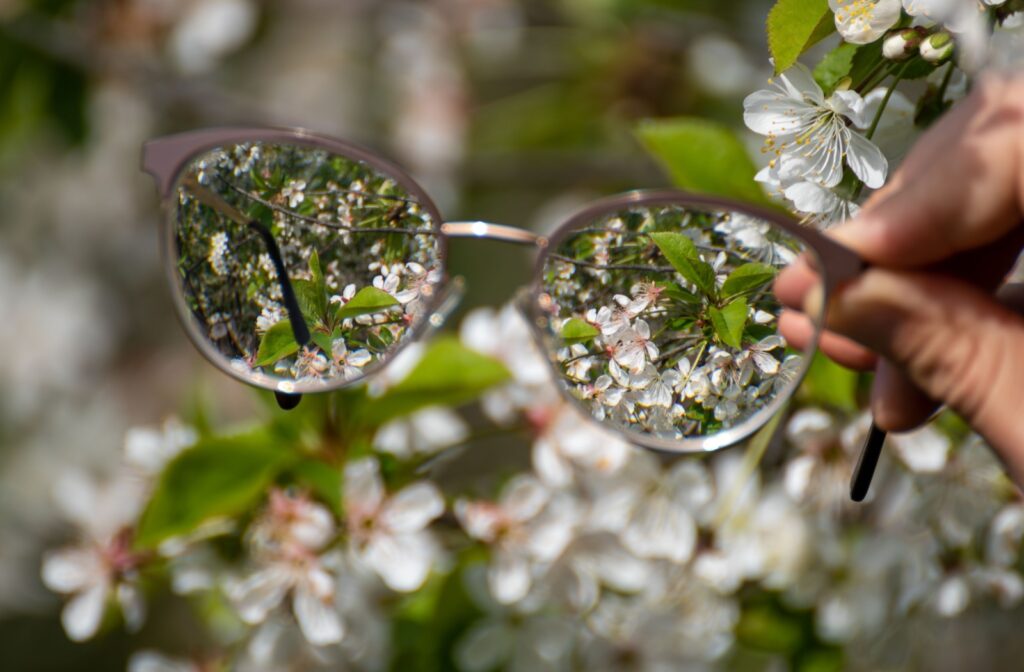
Fortunately, clear vision is achievable. Prescription glasses and contact lenses are designed to correct refractive errors by helping your eye focus light properly onto the retina.
Your vision can also change over time, so regular eye exams are a great way to monitor your eye health. A comprehensive exam can determine the prescription you need for clear, comfortable sight. When you speak with our eye doctors in Grants Pass, we can explore the options that work for you. At Central Eyes Optometry, our team is dedicated to helping you achieve clear and healthy vision. Schedule a visit to discuss your eyes and find a solution that fits your life.